
I like to compare the way we view our premises to the way we sometimes (very mistakenly) romanticise strangers. Anything, from far enough away, can appear perfect, glittering and complex. It’s context and content that makes us murky and flawed.
That’s why I sometimes struggle to develop my ideas into full-blown stories.
Over the course of the next twelve months, I’m embarking on a very exciting adventure. Arts Council England has awarded me a DYCP grant and as part of my proposal, I wanted to document that development. I wanted to share the knowledge I was able to learn about myself and my approach to the literary craft.
Over this month, I’ve been building a new idea in order to develop my creative practice, but where do you start when mapping out a fully fleshed story. Some dive straight in with pins on an empty map to guide them. Some have a fully fleshed-out map, with contours where mountains peak. Some are in between.
What I’ve learned from this time is that I am a planner through and through. While I relish in crafting the perfect sentence, I get a thrill from piecing together the story and unravelling a short logline or premise into a fully fleshed story world with lived-in characters.
But how do you go from a premise with so much glittering and complex potential to a perfectly crafted story? Everyone is different but this is my experience.

Having ADHD can present challenges as a writer – which is something rarely discussed. We frequently talk about rules we must follow and word counts we must hit to be considered a ‘real’ writer. But that’s completely false. But we all work differently. There is no right or wrong way to write.
I’ve found using a remarkable has a sensory experience which pulls me away from distractions and centres me while being creative. I write all my development documents by hand using this gadget.
It all starts with an idea.
Standing at the edges of the story map, I begin with an idea. It’s shapeless, to be honest. A brief idea. A glimpse of a fable. A crumb. From there I build a theme. So by the end of this process, I have two things.
- A logline
- A thesis statement
My thesis statement is what I want to communicate to the reader – the intention that follows me through every second of this writing process, and not only that, but it feeds every chapter, paragraph, and sentence. This is the essence of the story that makes the character’s journey mean something.
Exploration starts with a single step.
My first step onto the story map is writing three sentences. A sentence for the beginning, middle, and end. Not all stories have a three-act structure or follow a linear timeline, but it feels like a helpful spine for my story.
I accept these sentences will be imperfect, because just like any first draft – it will be far from finished. I write this brief outline knowing I will change it and then change it again until my gut instinct is happy to move on.
Padding.
Those humble three sentences are padded out, making sure to adhere to the 25/50/25 rule when dividing up the story beats. This is where I start to explore character, intention, what they are still yet to learn about the world – and in turn, what I want the reader to learn about the world.
This is the most whimsical and creative of my outlining process. This time is fluid. I build character sheets and write diaries. I explore complex relationships. Quirks. Flaws. Most importantly, I try to understand how the world made my characters the way they are. What didn’t they get enough of in their lives? What did they get too much of? What spoiled them or starved them? This helps me pad those three sentences into a…
One-pager.
My one-pager is an A4 page of writing where I dip my toe further in. I push on, exploring the story map deep into its centre. This one-pager is the foundation for my stories. Again, I keep to the 20/60/20 rule and try to throw as many challenges to my character in that middle section (knowing that’s the part I’ve always struggled with while writing).
Follow the map. Build a route.
Going by the book might not feel very creative and as you’re exploring these story beats, the illusion of complex potential might be flaking away. I try to remember in these moments that these events hinge on my execution later down the line. Especially as a literary fiction writer, I worry about stumbling too far into young adult or YA-like scenarios – and sometimes, when written simplistically in black and white., these beats can feel uncomplex and too straightforward – with little world-building to bring atmosphere.
That’s okay. When you look at a map or an atlas, you don’t see the lush fauna and flora of the world. You see simple lines. County perimeters. Roads. Rivers. You don’t see the breathtaking views. Embrace that. I’ve learned to enjoy this part of the process where I’m working with simple ingredients because a solid base can lead to a more intricate but sturdy structure.
For reference, I use this as a very brief guide to help put together my outlines. Here is a template I built to share with others (this pairs with the brief guide).
Walk the path you’ve forged for your character.
I’ve learned that I like to split my three acts into five – with the second act being split into three equal parts. From there, I write a list of sixteen scenes and/or prompts to write from. I prompt a word count for each scene, making sure each of the five segments works out at about 16,000 thousand words. This adds up to an approx. 80,000 words in total, which will be whittled down throughout the edit and fine-tuning.
This document is something I draft over and over again. I’ve spent days and weeks stewing over this segment for this particular I’ve spent days stewing over this segment because once that’s finished, I have no choice but to face the blank page.

Perhaps it’s my background in screenwriting. As a screenwriter, there is little focus on execution (especially at the beginning) but instead, the spotlight is cast on the story itself. While it’s your job to write in a compelling voice, the final execution of the story is down to a larger group of professionals.
What I’ve learned about myself is that I love solving the puzzle of how we craft stories so perfectly around a character that they are challenged, enlightened and encouraged within their story world. What is it specifically we can do to help the character to change and or make the tragic decision not to change?
Outlining is a process that works for me. I can understand why people like to dive in, inhibitionless, and get to the meat of it straight away, but having the safety net of this guide can be the light when the writing process is submerged in the dark.
The simple answer is an act of patience and exploration – a promise to look deeper than the surface level and spend time with an outline so you can examine the bigger picture strokes of the story and characters. It is a science of instinct and emotion – and there lies the challenge.
January reading recommendations:
- Into the Woods by John Yorke
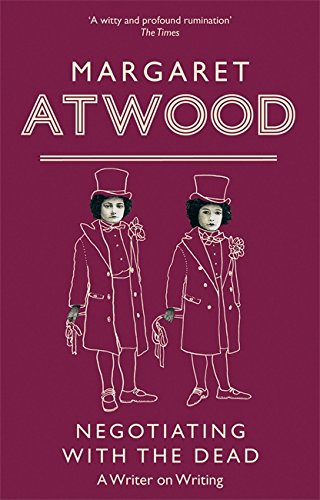
- Negotiating with the Dead by Margaret Atwood
- In the Margins by Elena Ferrante


If you want to know more about my Arts Council journey, please follow me on Twitter and Instagram for blog updates! I’ll be writing a monthly blog about the things I learn on my journey. You can see the Pinterest board for my project here and my Spotify playlist here.
I’m exceptionally grateful to Arts Council England, who awarded me a DYCP grant in early ’23. This grant has enabled me to take time to develop my creative practice, my voice and my craft. If you’re interested in applying for a grant, please see the ACE website for more information.

 lucy rose (writer)
Leave a comment